Some Reflections on the Election.
The dust is beginning to settle in respect of Newham and the local elections.
Nationally, Labour took a drubbing at the hands of Reform. Locally, Labour took a drubbing, but from a different direction.
Eight years ago Labour’s command of the borough seemed unassailable. In 2014 Labour took 60 seats out of 60 contested. In 2018, the situation was the same.
From 2002 to 2018 Labour and the mayoralty became increasingly popular. In 2014 the Labour mayoral Candidate took 61% of the vote, in 2018 she took 73%.
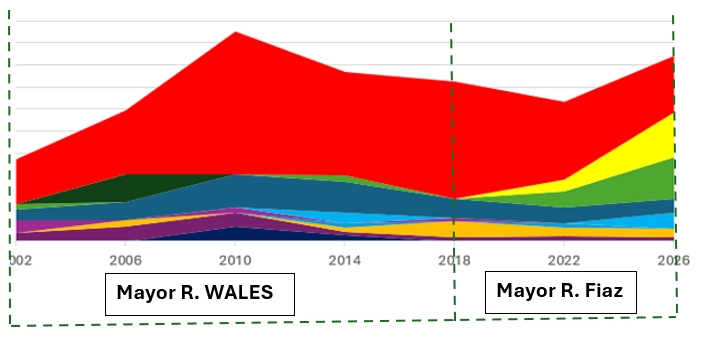
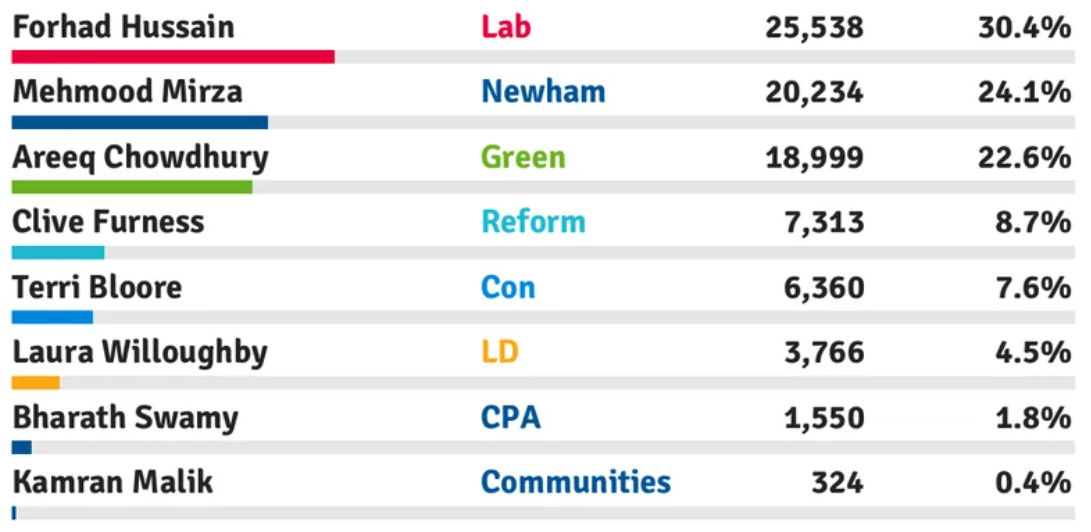
And then things began to slide. In 2022 Mayor Fiaz took 56% 0f the vote. By 2026 Forhad Hussain only managed 30%, it is to his credit that he managed to avoid a total wipe-out.
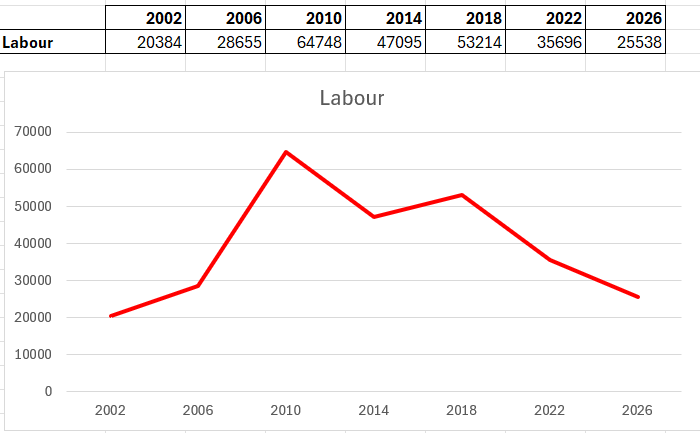
Expressed in a different way we can see the rise and fall of the Labour vote.
In 2022 there were 64 Labour councillors elected and two Greens, (there were subsequently byelections and defections that altered the balance, but in 2022 Labour had 64 of the 66 seats contested).
In 2026 Labour were only able to secure 26 councillors. Newham Independents secured 24 and the Greens took 16.
The inclination is to blame the candidate, but voters are more likely to base their choices on past experience. Fiaz inherited a well-run council that was popular with the electorate. Hussain inherited a basket case after eight years of Fiaz control.
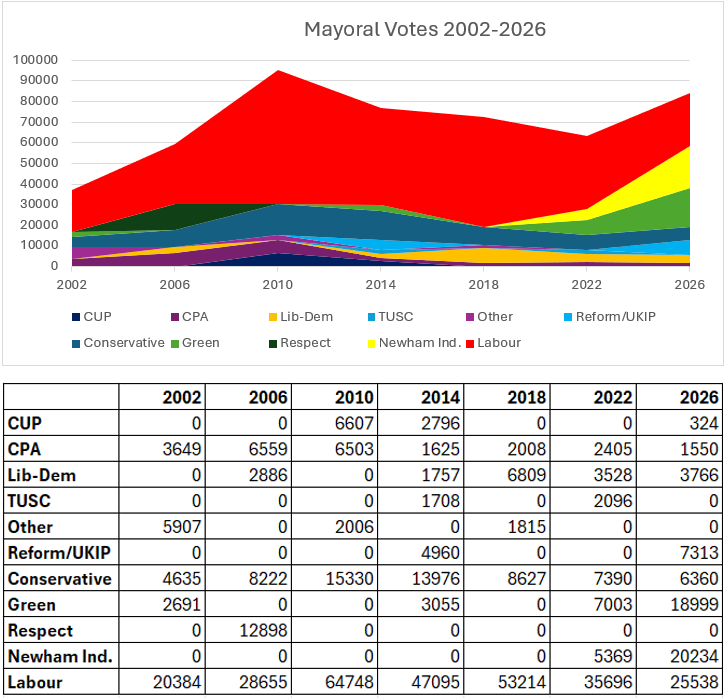
Looking at the mayoral vote since the mayoral system was introduced, (we used the excellent LEAP resource for data), we can see that not only Labour’s share of the vote is diminishing, but that there are now more people voting against Labour than for Labour (30%:70%). The 2026 election was conducted on a first past the post system. In future elections the transferable vote system will be reintroduced. Had the transferable vote system been in force in 2026 the outcome would have not been as favourable for Labour.
The 2026 mayoral results roughly mirrored the elections for council; Mehmood Mirza of Newham Independents took 24% of the vote, Areeq Chowdhury took 23% for the Greens.
Across the borough the turnout was reasonable at 35%. This hid the fact that in some wards it was under 30% while in others it was around 40%.
This was without doubt the most hotly contested election in living memory, sitting councillor, Tony McAlmont lost his seat to the Green candidate in Royal Albert by only two votes. Several wards now have a split representation from two parties.
The magnitude of the change suggests that this is more than a protest at high taxes and poor services. Gaza and the unpopularity of Keir Starmer and the government will undoubtedly have played a part in Labour’s unpopularity in Newham, but then, Labour were unpopular everywhere. There does seem to have been a distinct shift in voting patterns that might shape the future of the borough.
The Pakistani community has thrown its weight solidly behind Newham Independents who are represented on the council entirely by South Asians. They have been markedly more successful than Respect.
It seems that the antics of the Green Party leader and the antisemitism of some of his candidates around the country were not enough to put off all of the voters and the white middle classes have fallen in with the Greens (in Stratford Olympic Village they annihilated all of the opposition). It also appears that younger South Asian Muslim voters voted Green as opposed to Newham Independents.
For the first time in an election, we have seen wards split between two parties.
This is what the political map of the borough now looks like.
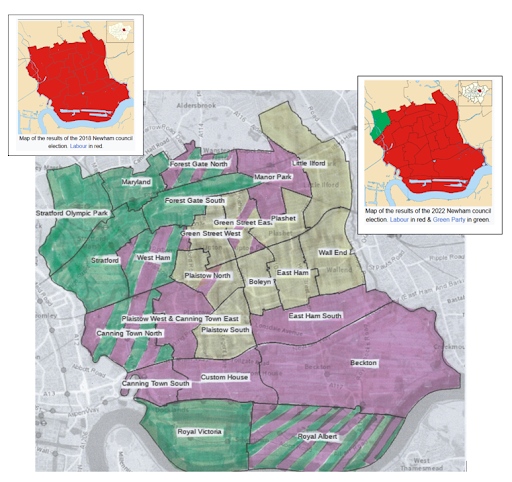
The 2026 result, with Wikipedia’s better graphics showing the 2018 and 2022 results.
As predicted, the Greens have done well amongst the younger and the more affluent. This suggests that the Greens will grow in influence. (We note that nationally Labour have become a lot less enthusiastic about the idea of giving votes to 16-year-olds!)
Against this is the fact that younger voters do, eventually grow up, (both literally and metaphorically). Voting Green today does not mean that you will be voting Green in four years’ time. We note that ex-Green Deputy Leader Shahrar Ali now describes his former party as “a danger to society” and a party that has been taken over by “Islamists and gender ideologues”. It has been reported to us that Caroline Lucas, the former leader of the Greens can now be found frequently at the National Liberal Club, which tends to suggest that she has abandoned the adolescent posturing of the current Green leadership.
In the centre and North East of the borough, Newham Independents have made their mark. We predicted that they would gain 20 seats. They have 24. The core of their vote is in the Pakistani community, supported by the wider South Asian Muslim vote, although we are given to understand that Bangladeshis tended to vote for Bangladeshis irrespective of the party in this election.
Labour remains the second party in the wards where Newham Independents made a clean sweep, so all is not lost for them. Following the 2003 invasion of Iraq, another Red-Green coalition in the shape of Respect made significant inroads into the Labour vote, taking almost a quarter of the votes cast. They lost it subsequently and Respect has now disappeared, with George Galloway setting up yet another party to pursue his political ambitions.
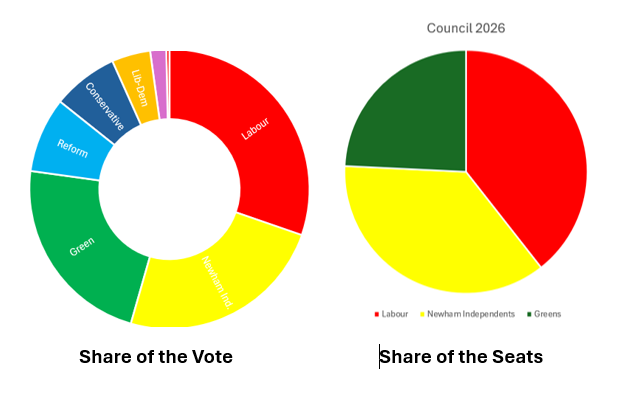
None of the smaller parties got the necessary critical mass to win a seat. Nonetheless, it is certainly a more representative council. Whether this will translate into better local government is yet to be seen.
New Mayor, Forhad Hussain has a number of problems on his plate. Not least of these are how he is going to fulfil his campaign promises while at the same time exercising control of the budget.
He will be the first mayor in Newham to face a hostile council; 40 of the 66 seats are held by opposition members. He is likely to face greater scrutiny over his budget than his predecessor. The scrutiny function of the council has the potential to be far more intrusive than that under Fiaz. This will depend in no small part upon the calibre of the new intake of councillors and that is as yet unknown.
On top of this he has a smaller and less experienced Labour Group upon which to rely for support. There is a residue of Fiaz loyalists and councillors who have excelled in nothing more than keeping their council seats warm. And he has his own collection of prima donnas and “swivel-eyed loons” amongst the new intake.
His appointment of Zulfiqar Ali, (Finance lead under Fiaz), as his cabinet member for Finance suggests that the talent pool is rather limited.
He has appointed John Gray to the post of Deputy Mayor, a position he held for some months under Fiaz, until he was sacked. Gray also holds the Housing brief with two major problems that have to be resolved; tackling the temporary accommodation crisis (the overspend) and fixing the housing maintenance issues that got the lowest possible score from the Housing Regulator. Gray is not known for his innovation, and he doesn’t have money to throw at the problem. It will be interesting to see what, if any, new initiatives we see from this quarter.
Hussain will shortly be appointing a new permanent Chief Exec. Whoever that is will have a challenge before them.